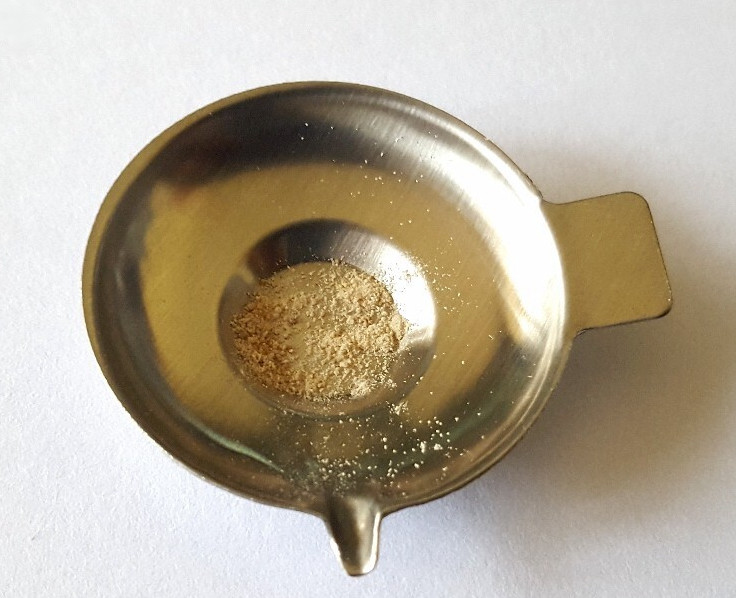
4-AcO-DMT sample, as identified by the photographer.
DMTrott · CC BY-SA 4.0
About 4-AcO-DMT
4-AcO-DMT, also called psilacetin or O-acetylpsilocin, is a synthetic tryptamine. It is different from psilocybin, N,N-DMT and 5-MeO-DMT.
Also searched as: 4aco dmt · 4 aco dmt · Psilacetin · O-acetylpsilocin
Buy 4-AcO-DMT: pricing & legal access
4-AcO-DMT online: availability & product information
A “research chemical” label is not approval for human consumption or proof of legality. DrugRX has not established a lawful consumer medicine supply or verified pharmacy price. Legal treatment may depend on analogue laws and jurisdiction.
Pricing status: No live price feed or verified quote. DrugRX does not sell or dispense products.
Sources: DEA — Controlled-substance analogue guidance and statutory references
4-AcO-DMT information
What research establishes
Laboratory work has examined its metabolism using human liver microsomes. That model helps identify possible metabolites but does not establish a medicine’s effectiveness, a clinical dose or long-term safety in people.
Risks and unknown ingredients
CDC investigated severe illnesses involving mushroom-branded products, some of which contained psychoactive substances including 4-AcO-DMT. Products could contain multiple ingredients, so the investigation does not establish that this compound alone caused every outcome.
Sources: CDC — Mushroom-product poisoning investigation (2026)
Dosage and evidence gaps
DrugRX does not provide a recreational or self-treatment dose. The cited metabolism experiment is not a human dosing study, and a package’s “microdose” claim does not resolve composition or safety uncertainty.
Sources: Laboratory study of psilacetin metabolism (2022) · CDC — Mushroom-product poisoning investigation (2026)
Interactions and clinical uncertainty
The sources cited here do not provide a validated consumer interaction table. Do not assume that interactions, contraindications or safety findings for psilocybin transfer unchanged to psilacetin.
Psilacetin and psilocin
4-AcO-DMT is an acetylated psilocin-related compound. Psilocybin, psilocin and psilacetin have different structures; a proposed metabolic relationship does not mean that the original substances are identical.
What the metabolism experiment measured
The cited experiment used pooled human liver microsomes and mass spectrometry to investigate possible metabolites. This is an in-vitro model, not a randomized treatment trial in patients. Laboratory metabolism findings answer a narrower question than clinical safety.
Mushroom branding and product identity
A mushroom-branded chocolate or gummy may contain ingredients that do not match a customer’s expectation. CDC’s poisoning investigation involved products with potentially multiple psychoactive ingredients. Packaging language cannot attribute an effect to one molecule.
Sources: CDC — Mushroom-product poisoning investigation (2026)
4-AcO-DMT versus mushroom material
An isolated synthetic chemical and a mushroom specimen are different materials. The specimen can contain variable amounts of several compounds; an unverified powder can also have uncertain identity. Neither label establishes a controlled clinical preparation.
Sources: Laboratory study of psilacetin metabolism (2022) · Controlled study of 14 P. cubensis strains (2026)
Sources and editorial notes
Prepared by DrugRX using the references linked below. Sources were consulted on 2026-10-31. This page has not been independently reviewed by a clinician. Research findings, medication approval and legal permission are separate questions.
- Laboratory study of psilacetin metabolism (2022)
- CDC — Mushroom-product poisoning investigation (2026)
- Controlled study of 14 P. cubensis strains (2026)
- DEA — Controlled-substance analogue guidance and statutory references
Legal information is a dated U.S. reference. Product rules and local laws may change. Where the evidence does not establish a dose, interaction profile or price, the page states that limitation.